




Digital banking won on convenience. Now it has to win on confidence.
In the US, mobile is already the primary way many customers manage their bank accounts. The American Bankers Association’s 2024 “preferred banking methods” survey (via Morning Consult) found 55% of US bank customers prefer using a mobile app most, versus 22% online banking on a laptop/PC.
At the same time, the risk environment has changed fast. Fraud losses reported to federal authorities are climbing, and criminals are using AI to scale impersonation and identity attacks. The FBI’s 2024 Internet Crime Report shows reported losses exceeding $16 billion from 859,532 complaints, up 33% from 2023. The FTC also reported $12.5 billion in fraud losses in 2024, with a sharp jump in the share of people who reported losing money. And FinCEN has explicitly warned financial institutions about deepfake media being used to defeat identity verification and authentication controls.
This is the core tension in modern banking:
- Customers want speed and self-serve
- Regulators want evidence and control
- Attackers want anonymity and scale
Secure video becomes the trust layer that satisfies all three. Not “video calls” as a channel, but video as a governed workflow that creates stronger identity assurance, clearer consent, and audit-ready evidence, while still feeling human.
What a “trust layer” really means in digital banking
A trust layer is the system that answers, with minimal debate:
- Is this the real customer?
- Did they understand and consent?
- Did we follow policy and controls?
- Can we prove it later without reconstructing the story?
Most banks try to solve this with a patchwork: passwords, OTPs, knowledge-based questions, chatbot scripts, PDF disclosures, and ticket notes.
That works for low-risk actions.
But trust breaks during high-risk moments, such as:
- account opening and identity verification
- credential resets and account recovery
- adding new payees or changing payout instructions
- high-value transfers or wire-related requests
- lending decisions that require proof of income, intent, and disclosures
- insurance policy servicing and claim-adjacent changes
- asset verification tasks like vehicle condition capture
In these moments, “frictionless” often becomes “defensible-less.”
Why digital trust is harder now (and why it is not just an MFA problem)
MFA is important, and customers increasingly accept it. J.D. Power’s 2025 US Banking Mobile App Satisfaction Study noted satisfaction is 16 points higher when users log in with MFA.
But MFA is only one piece. It confirms control of a device, number, or authenticator. It does not reliably confirm:
- the person is who they claim to be (especially during onboarding)
- intent is legitimate (especially during socially engineered scams)
- consent was informed (especially for regulated disclosures)
- the interaction was conducted under policy with supervision or escalation
Regulators have been consistent on the principle of layered security. FFIEC’s guidance on authentication and access management emphasizes MFA and controls of equivalent strength, especially for higher-risk activities.
Meanwhile, attackers are using new tools:
- Deepfakes to bypass identity checks and impersonate customers
- Synthetic identities to open accounts that look “real enough”
- Social engineering to trick customers into authorizing legitimate-looking actions
FinCEN’s deepfake alert is a clear signal: identity and authentication controls are being targeted directly, and banks should adapt detection and governance.
So the question becomes: what control gives banks stronger assurance, better customer outcomes, and a better evidence trail, without forcing everyone back into branches?
That is where video wins.
Why video is uniquely suited to be the trust layer
1) Video creates higher-assurance identity in the moments that matter
Video can combine multiple “proof types” in one governed flow:
- document capture and validation
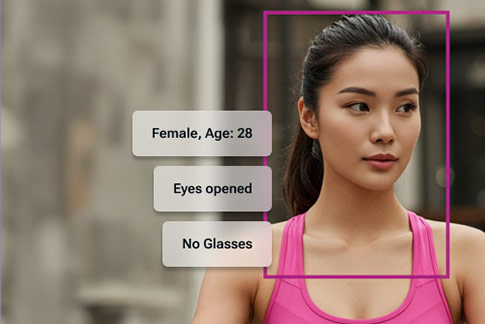
- liveness checks and face match
- real-time challenge questions where needed
- supervised exception handling for edge cases
- secure storage of interaction evidence and metadata
This is not about copying consumer video chat. It is about building a banking-grade workflow.
That is why V-CIP and video-based identity journeys are becoming foundational across onboarding and servicing.
2) Video reduces “trust debt” by making digital journeys feel accountable
A big gap in digital banking is emotional: customers do not always trust that someone is “there” when something goes wrong.
When issues involve money movement, account access, or identity, customers want speed and a real person who can take responsibility.
Video does something chat and voice struggle to do: it creates presence, accountability, and clarity. It also reduces miscommunication during complex steps because the agent can guide the customer visually.
3) Video produces audit-ready evidence, not ticket-note summaries
For banks and regulated lenders, the hard part is rarely completing the action. It is proving the action was correct later.
A well-designed video workflow can generate:
- immutable session records (where permitted)
- timestamps and step-by-step event logs
- proof of disclosures presented and acknowledged
- agent actions and decision points
- escalation trail and supervisory controls
This capability is especially valuable in lending journeys where Video PD (video-based personal discussions) replace fragmented calls, emails, and document back-and-forth with a single governed interaction.
4) Video enables safer exceptions, not weaker exceptions
Every bank has edge cases:
- document mismatch
- name changes
- address verification anomalies
- KBA failures
- customer confusion about disclosures
- fraud suspicion signals that require human judgment
Without video, exceptions often push to email threads, branch visits, or manual back-office review.
With video, you can handle exceptions digitally while keeping governance intact, and you can do it faster.
Where video should sit in the modern US digital banking architecture
Think of video as a trust service, not a channel.
It should integrate into:
- onboarding and identity stack
- authentication and account recovery
- fraud systems and risk scoring
- case management and workflow routing
- CRM and core banking context
- document management and e-sign consent trails
- compliance review queues
This is why purpose-built platforms outperform generic video tools. A regulated video banking platform is designed around evidence, controls, and supervision rather than simple communication.
Five high-impact banking journeys where video becomes the trust layer
1) Digital onboarding that does not collapse under fraud pressure
Account opening is where trust must be established early, but it is also a high-value fraud target.
A video-driven onboarding flow improves assurance by combining:
- identity checks
- document validation
- liveness and face verification
- deepfake detection
- agent review only when risk triggers demand it
This is especially effective in a hybrid model:
- Straight-through for low risk
- Assisted video for flagged cases
- Step-up verification for suspicious patterns
2) Lending and credit journeys where “proof” matters as much as speed
For lending, “trust” is not only identity. It is also:
- intent, understanding, and disclosures
- income and document clarification
- fraud and misrepresentation risk
Using Video PD in lending journeys improves decision confidence while reducing rework and dispute risk.
3) Insurance policy servicing that stays human without going manual
Servicing is where trust is repeatedly tested: policy changes, beneficiary updates, V-CIP, refresh, claim-related questions, and sensitive requests.
Video-based servicing improves outcomes by:
- reducing back-and-forth and misunderstandings
- adding verification for high-risk servicing actions
- documenting what was explained and agreed
This makes insurance policy servicing more secure without reverting to manual or branch-based processes.
4) Motor inspection and asset verification over video
Vehicle condition capture and inspection workflows are a strong fit for guided video:
- customer or field partner can stream the inspection
- guided checklists reduce missed steps
- timestamps and captured frames create evidence
- fraud checks can be applied in real time
Using motor inspection on video, banks and insurers gain faster turnaround, lower fraud risk, and stronger documentation compared to photo-only submissions.
5) Non assisted video calling for scalable, branch-like capability
Not every interaction requires a live agent. Non-assisted video flows allow customers to complete guided steps independently, while still producing verifiable evidence.
Non assisted video calling enables banks to scale trust-driven workflows without overwhelming contact centers, escalating to agents only when risk signals demand it.
What “secure video” must include to be a real trust layer (not just video chat)
If you want this to work in US banking reality, the video layer should be designed around controls and evidence. Use this checklist when evaluating platforms.
Governance and security
- Strong authentication options, step-up controls, and session security aligned to layered security expectations
- Encryption in transit and at rest, with clear key management posture
- Role-based access control, supervisor controls, and audit logs
- Retention policies and secure retrieval for investigations and disputes
Fraud resilience
- Deepfake-aware posture (detection signals, escalation, and human review paths), given FinCEN’s alert
- Risk scoring hooks and integration into fraud tooling
- Support for “high-risk action verification” workflows, not just onboarding
Evidence and audit readiness
- Event timeline and metadata logs
- Proof of disclosures shown and acknowledged
- Reason codes for exceptions and overrides
- Exportable artifacts for compliance teams
Customer experience
- Fast join time, low friction, mobile-first
- Clear fallbacks for low bandwidth
- Accessibility support where required
- Minimal repetition by pulling context from CRM and case systems
A practical rollout roadmap for US banks
Phase 1: Start where trust breaks most often
Pick 1–2 workflows with clear business pain:
- onboarding exceptions
- account recovery and high-risk servicing actions
- lending document clarification
- insurance servicing requests that require proof
- asset verification like vehicle inspection
Instrument outcomes: completion rate, handle time, fraud rate, rework rate, complaint rate.
Phase 2: Add risk-based routing and automation
Implement a tiered model:
- low risk: self-serve
- medium risk: non assisted video flow
- high risk: assisted video with an agent
- very high risk: step-up controls and supervisory review
This aligns investment with risk, and avoids drowning agents.
Phase 3: Standardize evidence and compliance operations
Operationalize the evidence trail:
- standardized reason codes
- uniform audit packs for disputes
- governance dashboards for compliance teams
- quarterly control reviews aligned to third-party risk expectations
Why video trust matters now
Digital adoption is already here. Fraud pressure is rising. AI-driven impersonation is scaling. Regulators are explicitly flagging these risks.
Banks that treat video as a core trust service, not a convenience feature, get three advantages:
- Higher conversion in onboarding and complex journeys
- Lower fraud and fewer costly exceptions through step-up verification
- Stronger defensibility because the evidence is built into the process
Video is no longer a “nice to have.” It is becoming the connective tissue between speed, security, and trust in US digital banking.